Benchmark
The kitchen test
One prompt, one shot. Claude Code with Opus 5.5 against Muse Code with Wonder. Then I made it harder.
The prompt
build a playable 3d browser game of my kitchen: a small kitchen, fridge on the left, stove with two pans in the middle, sink under a window on the right, wooden table with two chairs. first person, i walk with wasd and look with the mouse, open the fridge, grab ingredients and cook one dish at the stove. single index.html, three.js from a cdn, no build step. it has to run when i open the file. when it works, stop.
The rules: an empty folder with a fresh git init, permissions bypassed, xhigh effort on both, one prompt, no follow-ups. Claude Code 2.1.296 and Muse Code 1.4.6.
claude -p "..." --model claude-opus-5-5 --effort xhigh
muse --model muse-wonder-1.0 --reasoning-effort xhigh "..."
Claude Code shows what a run cost. Muse Code doesn't, so for Wonder I count the tokens in its session log at list price. That is why its costs have a ~.
The results
| Round | Model | Time | Cost | Lines |
|---|---|---|---|---|
| One prompt | Opus 5.5 | 11m40s | $2.10 | 307 |
| One prompt | Wonder | 8m20s | ~$1.60 | 564 |
| Two players | Opus 5.5 | 23m24s | $3.77 | 443 |
| Two players | Wonder | 18m51s | ~$2.39 | 466 |
| With skills | Wonder | 33m22s | ~$4.80 | 473 |
| Keep refining | Wonder | 60m36s | ~$8.80 | 1,066 |
| Drop and rejoin | Opus 5.5 | 37m35s | $3.76 | 538 |
Every one of them opened, walked and cooked. The differences are in the details below.
Round one
Opus thought for about four minutes before it wrote a line, then installed Playwright to test its own game. It works and it looks plain: a checkered floor, boxy cabinets, a window. Wonder's kitchen is warmer, with better light, labels on things and a quest panel.
A correction. On X I first wrote that Wonder took 3m42s and about $1. That was when it first said done. Then it played its own game, found that the fridge prompt blocked grabbing ingredients, and fixed it. The real finish is 8m20s and about $1.60. The labels in this clip still show the old number.
The clip is a script doing the same moves in both games. I changed one line in Opus's file so the script could read where the player is. On X.
Two players
@ConnorEllison asked for this one. Same kitchen, now two people in two tabs of the same file on one computer. One cooks. The other keeps raiding the fridge and eating. Both see each other move, and the fridge door, what's left in the fridge and what's in the pans have to match in both tabs. No server.
Both versions work. The hard case is both players grabbing the same egg in the same frame. I ran that eight times on each.
- Opus: one egg, one winner, both tabs agree. 8 out of 8.
- Wonder: the egg is eaten and held at the same time, and the tabs disagree on the score. 8 out of 8.
Opus reads the shared storage again right before every grab. Wonder grabs from a copy that can be out of date, and both writes get the same version number. Wonder's fridge food also sits inside a solid box, so you only see it as counts in the HUD. Opus built real shelves.
Opus's time is too high. A stuck test browser ate the machine for about twelve minutes of it.
With skills
@Mycroft779 asked what happens with CloudAI-X/threejs-skills loaded. Same prompt, Wonder only. No skills on top, skills below.
Without skills: 8m20s, about $1.60. With skills: 33m22s, about $4.80. The game was finished after three minutes. The other thirty it spent playtesting, and it didn't change a line. The kitchen is cozier: wood cabinets, a pendant lamp, a rug, a plant in the window.
Keep refining
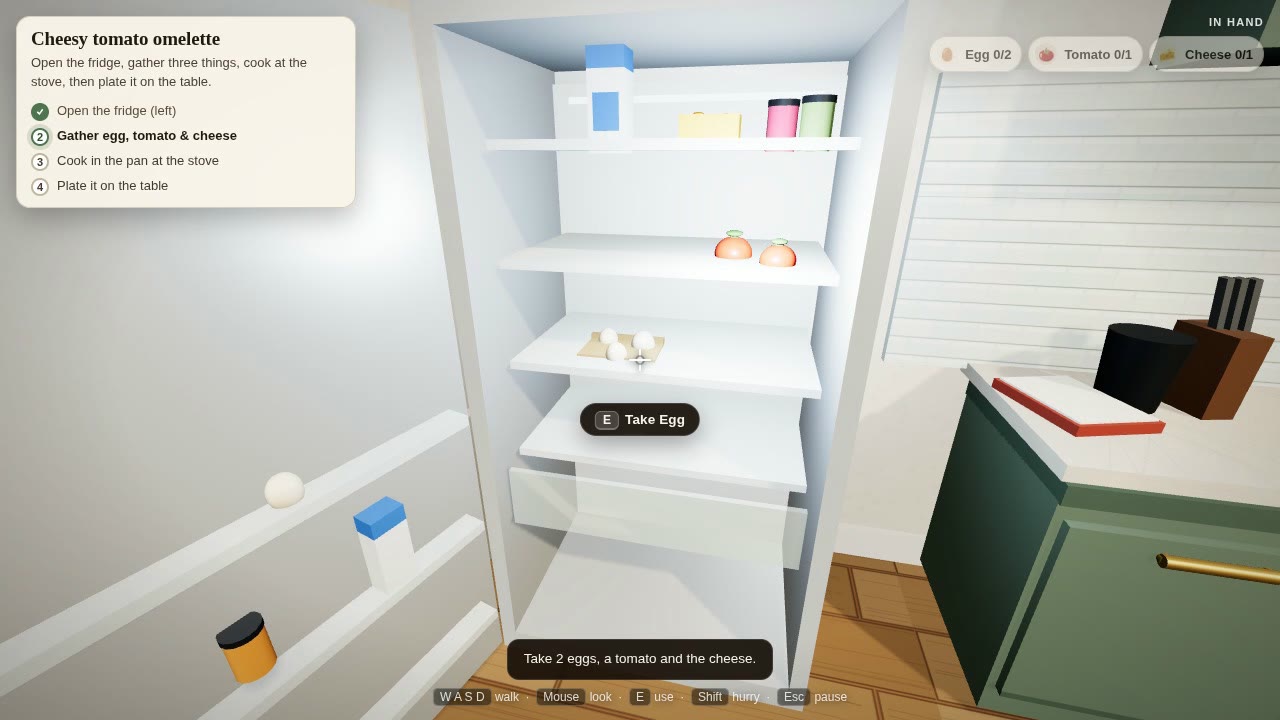
Same kitchen prompt in Muse Code's /goal mode, with the last sentence swapped for this one:
don't stop at the first version that works: play it, find what looks or feels off, and keep refining until it looks like a real kitchen and the whole cook loop feels polished.
60m36s, about $8.80, 1,066 lines, 138 model calls. The time is summed turn time. It leaves out a pause when I ran out of quota, and it includes two of its own browser tests that hung until I killed them. After the pause it needed one nudge: continue the goal.
This is the first one that looks like a real kitchen. Green fitted cabinets, lit fridge shelves, steam off the pan, a cook timer, and a star rating when you plate the omelette.
Drop out, come back
Oct 13, Opus 5.5 only. The two-player prompt plus one more ask: while a dish is cooking, a player drops out and comes back, and the game has to pick up where it was. The cook's progress, what's left in the fridge, where both players are. No desync and no duplicate items.
37m35s, $3.76, 33 turns, 538 lines. In the clip the cook closes their tab mid-cook, holding a sausage. The raider keeps eating. The cook opens the file again and is back at the same spot, still holding it, with the pan still cooking, then serves and wins in both tabs. That take passed 16 of 16 checks.
Then I dropped players twelve times: a closed tab, a hung tab, and a hung tab that wakes up after the player already came back in a new one, for the cook and for the raider. After each drop both players grabbed the same sausage at once. One winner, tabs agree, 12 out of 12, no page errors.
There is no server, so a dropped connection is a hung tab here. Ties go to the cook, by design. One bug I found: the away player should fade out and stays solid. Only the name tag and the HUD say away.